

Artificial intelligence has moved beyond general-purpose chatbots. Businesses are now building AI-powered customer support systems, internal knowledge assistants, recommendation engines, document-processing tools, coding assistants, and industry-specific applications.
However, a common question arises when developing these applications: Should you use Retrieval-Augmented Generation (RAG), fine-tune an AI model, or combine both approaches?
RAG and fine-tuning solve different problems. RAG gives an existing AI model access to external or private information at the time of a query, while fine-tuning changes the model’s behavior by training it further on task-specific examples.
Choosing the right approach depends on your application’s objectives, data, update frequency, accuracy requirements, budget, and expected user experience.
What Is Retrieval-Augmented Generation (RAG)?

Retrieval-Augmented Generation (RAG) is an architecture that connects a generative AI model with an external knowledge source. Instead of asking an AI model to answer entirely from information learned during its original training, a RAG application first searches a connected knowledge base and provides relevant information to the model as context.
Google Cloud describes RAG as a combination of information retrieval and generative AI. The retrieval system finds relevant information, and the language model uses that information to generate the response.
How Does RAG Work?
A typical RAG application follows several steps:
1. Collect the information
The business gathers relevant information from sources such as:
- PDFs
- Product documentation
- Websites
- FAQs
- Knowledge bases
- Internal policies
- Customer-support documents
- Databases
- SharePoint or Confluence content
2. Prepare the information
Documents are cleaned, divided into smaller sections, and converted into representations called embeddings. These embeddings allow the system to identify information that is semantically related to a user’s question.
3. Store the information
The processed information can be stored in a vector database or another retrieval system.
4. Receive a user question
For example:
“What is your company’s refund policy for annual subscriptions?”
5. Retrieve relevant information
The RAG system searches the connected knowledge base and retrieves the sections related to refunds and annual subscriptions.
6. Generate the answer
The retrieved information is supplied to the AI model as context. The model then generates an answer based on that information.
This architecture allows an application to use changing or proprietary information without retraining the underlying model every time the information changes.
Example of RAG in a Business Application
Imagine an e-commerce company has an AI customer-support assistant.
Its product catalog changes every week. Prices, specifications, warranty policies, return conditions, and stock information can also change frequently.
Training a model every time this information changes would be inefficient.
With RAG, the application can connect the AI assistant to the company’s current product database and documentation.
A customer asks:
“Does the 55-inch television come with a five-year warranty?”
The system retrieves the relevant product and warranty information and uses it to formulate the answer.
If the warranty information changes, the company can update the connected knowledge source rather than retraining the entire AI model.
This is one reason RAG is particularly useful for applications that depend on current, proprietary, or frequently changing information.
What Are the Main Benefits of RAG?
1. Access to Current Information
One of RAG’s biggest advantages is that the application can retrieve updated information when users ask questions.
This makes RAG suitable for:
- Customer-support applications
- Product assistants
- Internal knowledge systems
- Policy assistants
- Documentation search
- Enterprise search
- Frequently updated catalogs
2. Works With Private Business Data
A general-purpose AI model may not know your company’s internal information.
RAG can connect the application to private documents and databases so the AI can use that information when responding.
3. Easier Knowledge Updates
Suppose a company changes its employee leave policy.
With a RAG system, the updated policy can be added to the knowledge base. The AI application can then retrieve the new information.
This is much more practical than repeatedly retraining a model whenever a document changes.
4. Better Source Traceability
RAG applications can be designed to show the documents or sources used to generate an answer.
For example:
Answer: Employees receive 18 annual leave days.
Source: Employee Leave Policy, Section 4.2.
This can improve transparency and make answers easier to verify. AWS specifically identifies source references as an advantage of RAG compared with fine-tuning.
5. Access Control Can Be Built Into Retrieval
A business can design retrieval systems around user permissions.
For example, an HR employee might access HR policies while a sales employee receives access only to sales documentation.
Google Cloud notes that RAG can support control over which grounding data different users can access.
What Is Fine-Tuning?
Fine-tuning involves taking a pretrained AI model and training it further on a specialized dataset so that it performs a particular task or behaves in a particular way.
In simple terms:
RAG gives the model information.
Fine-tuning teaches the model how to behave or perform a specific task.
Google Cloud describes fine-tuning as further training a pretrained model using a task-specific dataset.
Fine-tuning can be useful when the problem is not simply “the model doesn’t know my information,” but rather “the model needs to perform this task in a particular way.”
How Does Fine-Tuning Work?
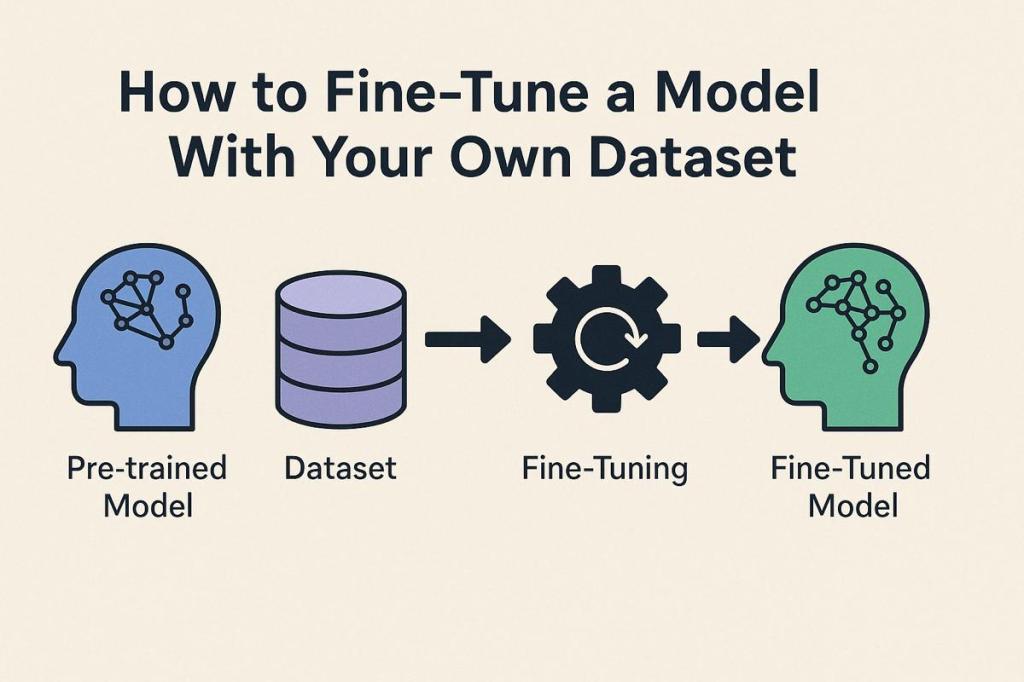
Suppose a company wants an AI system that converts customer complaints into structured categories.
The company could provide many examples such as:
Input:
“My package arrived damaged.”
Expected output:
Category: Product Damage
Priority: High
Another example:
Input:
“I received the wrong color.”
Expected output:
Category: Incorrect Product
Priority: Medium
During fine-tuning, the model learns patterns from these examples.
The objective is to improve its performance on similar tasks.
Fine-tuning can therefore be useful for:
- Classification
- Structured output generation
- Specific writing styles
- Industry terminology
- Specialized workflows
- Repetitive AI tasks
- Consistent response formats
Google Cloud identifies specialized terminology, task accuracy, brand style, cost optimization, and difficult edge cases among situations where fine-tuning can be considered.
Example of Fine-Tuning
Consider a legal technology company that wants an AI system to classify legal documents into predefined categories.
The company could provide thousands of examples:
- Employment Agreement → Employment
- Lease Agreement → Real Estate
- Confidentiality Agreement → NDA
- Purchase Agreement → Commercial
The model can be fine-tuned to become better at this particular classification task.
Notice the difference from RAG.
RAG would help the AI retrieve information about a particular document or policy.
Fine-tuning would help the AI perform the classification task more consistently.
RAG vs Fine-Tuning: The Core Difference
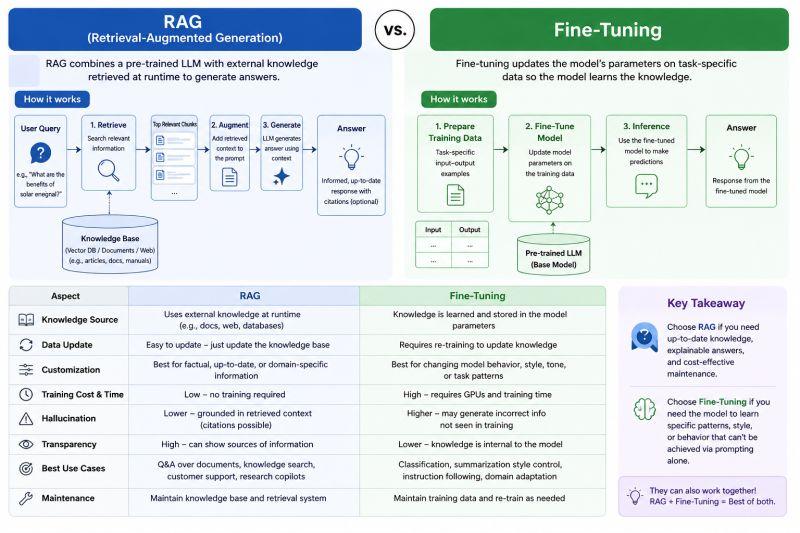
The easiest way to understand the difference is to think about a new employee.
RAG is like giving the employee access to the company’s knowledge library.
When a question comes up, the employee searches the library and finds the relevant information.
Fine-tuning is like training the employee to perform a particular job according to company standards.
The employee learns how to categorize requests, follow a particular format, communicate in a particular style, or complete a specialized task.
Neither approach is universally better.
They address different requirements.
RAG vs Fine-Tuning: Detailed Comparison
| Factor | RAG | Fine-Tuning |
|---|---|---|
| Main purpose | Add external knowledge | Change or specialize model behavior |
| Private data | Excellent | Possible, but not usually the first choice for changing knowledge |
| Frequently changing information | Excellent | Less suitable |
| Specific writing style | Limited | Strong |
| Specialized task | Good with appropriate prompting | Often strong |
| Source citations | Can be implemented | Not inherently provided |
| Knowledge updates | Usually easier | Requires additional training |
| Initial complexity | Moderate | Higher |
| Training required | No model retraining | Yes |
| Data requirement | Knowledge documents/data | High-quality training examples |
| Best for | Knowledge-intensive applications | Task-specific behavior |
AWS recommends starting with RAG when the primary requirement is answering questions using custom documents, while fine-tuning can be more appropriate for additional tasks such as specialized summarization.
When Should You Choose RAG?
RAG is generally the stronger choice when your application needs to answer questions using current or proprietary information.
Choose RAG when:
Your information changes frequently
Examples include:
- Product prices
- Inventory
- Company policies
- Financial information
- Travel information
- Technical documentation
You need citations or references
If users need to verify where an answer came from, RAG is generally preferable.
You have a large document library
For example, an enterprise might have thousands of:
- Manuals
- Contracts
- Policies
- Reports
- FAQs
- Knowledge articles
RAG can retrieve relevant sections instead of putting the entire collection into every prompt.
You want a private knowledge assistant
For example:
Employee: “What is the company’s parental leave policy?”
The application retrieves the relevant HR policy and generates an answer.
This is a classic RAG use case.
When Should You Choose Fine-Tuning?
Fine-tuning becomes attractive when the primary challenge is how the model performs a task, rather than access to constantly changing information.
Choose fine-tuning when:
You need a consistent output format
For example, a company wants every customer complaint converted into:
Issue:
Category:
Priority:
Recommended Action:
A carefully prepared fine-tuning dataset can help the model consistently follow the desired pattern.
You need a specific communication style
A company may want AI-generated content to follow a highly specific brand voice.
Fine-tuning can help the model reproduce patterns demonstrated in training examples.
Your application performs one specialized task repeatedly
For example:
- Invoice classification
- Customer-intent classification
- Product description generation
- Specialized text transformation
- Document categorization
You need to optimize a high-volume workflow
For some applications, a smaller fine-tuned model may be more economical or faster than repeatedly using a larger general-purpose model. Google Cloud identifies reduced costs and latency as potential benefits in high-volume use cases.
When RAG Is Better Than Fine-Tuning: Example
Imagine a hospital information assistant that needs to answer questions about hospital policies.
The policies change periodically.
Question:
“How many days can a patient stay in the rehabilitation program?”
If the answer exists in a current policy document, RAG is a natural fit.
The application retrieves the current policy and generates the answer.
Fine-tuning would be less suitable as the primary mechanism for storing this frequently changing information because updating the model would require additional training.
AWS specifically notes that fine-tuning may not be a good solution when custom documents change frequently.
When Fine-Tuning Is Better Than RAG: Example
Now consider an AI application that must convert customer emails into a standardized JSON-like structure.
The application receives:
“I ordered a blue shirt but received a black one.”
The desired result might be:
Issue: Wrong Product
Category: Order Error
Priority: Medium
Here, the primary requirement isn’t access to a knowledge database.
The application needs to consistently understand and classify customer messages.
Fine-tuning may therefore be more appropriate than using RAG alone.
Can You Use RAG and Fine-Tuning Together?
Yes.
In fact, combining the two can be an effective strategy for some advanced applications.
AWS explicitly describes hybrid architectures that combine RAG with fine-tuning.
Consider a customer-service AI application.
The company wants:
- The AI to follow its specific communication style.
- The AI to understand customer-service terminology.
- The AI to use the latest product documentation.
- The AI to provide answers based on current policies.
Fine-tuning can help with behavior, style, and task performance.
RAG can provide current product and policy information.
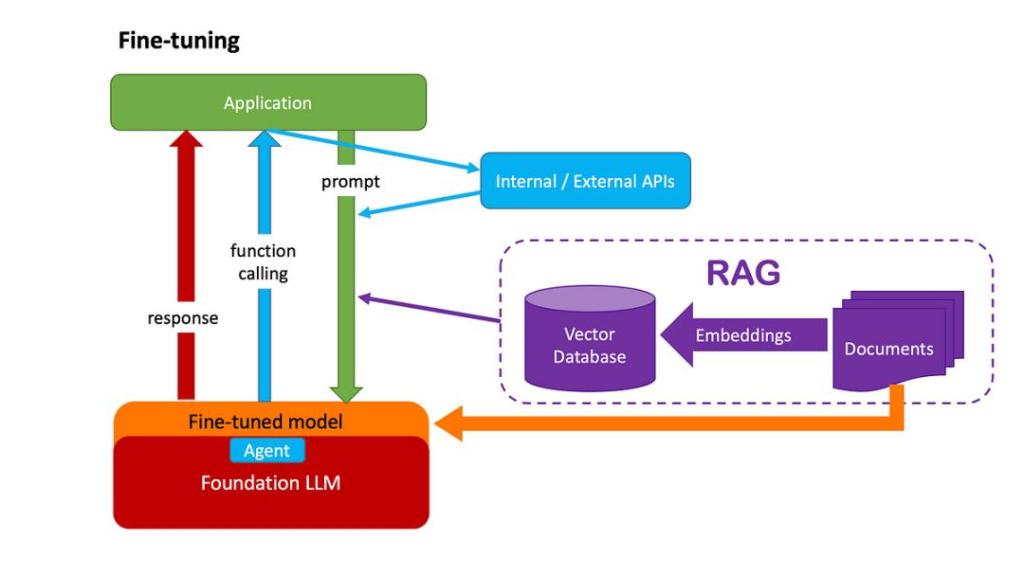
The resulting architecture could look like:
User Question → Retrieval System → Relevant Business Information → Fine-Tuned AI Model → Final Answer
This hybrid approach can provide both specialized behavior and access to changing information.
RAG vs Fine-Tuning: What About Hallucinations?
Neither approach automatically eliminates hallucinations.
RAG can reduce the risk by grounding responses in retrieved information, but the retrieval system must return relevant and high-quality content.
For example, suppose a customer asks:
“What is the warranty period?”
If the retrieval system finds the wrong document, the AI may still produce an incorrect answer.
Google Cloud emphasizes that retrieval quality is critical to RAG performance. Poor retrieval can result in irrelevant or incorrect responses even when the generation system itself works properly.
Fine-tuning can also improve task-specific behavior, but it should not be treated as a replacement for a current knowledge source.
AWS notes that fine-tuned models do not inherently provide source references and may carry increased hallucination risk for question-answering use cases.
Common Mistakes Businesses Should Avoid
Mistake 1: Fine-Tuning a Model Just to Add Company Documents
If the main requirement is answering questions from frequently updated company documents, RAG is usually the more practical starting point.
Mistake 2: Assuming RAG Automatically Produces Accurate Answers
A poorly designed retrieval system can retrieve irrelevant information.
RAG needs:
- Good document preparation
- Appropriate chunking
- Effective embeddings
- Strong retrieval
- Re-ranking where appropriate
- Access controls
- Evaluation
- Monitoring
Mistake 3: Fine-Tuning Without High-Quality Training Data
Fine-tuning depends heavily on the quality and consistency of the training examples.
Poor examples can teach the model undesirable patterns.
Mistake 4: Ignoring Evaluation
AI applications should be tested using representative questions and expected outcomes.
For RAG applications, teams should evaluate both:
Retrieval quality: Did the system find the right information?
Generation quality: Did the model use that information correctly?
Google Cloud highlights evaluation as an important part of building reliable RAG systems because retrieval failures can otherwise remain hidden.
RAG vs Fine-Tuning: A Simple Decision Framework
Ask these questions before choosing an approach:
Do you need the AI to access frequently changing information?
→ Consider RAG.
Does the AI need access to private company documents?
→ Consider RAG.
Do users need source references?
→ RAG is generally the better choice.
Does the AI need to perform one specialized task consistently?
→ Consider fine-tuning.
Does the AI need a very specific writing style or response behavior?
→ Consider fine-tuning.
Do you need both specialized behavior and current business knowledge?
→ Consider RAG + fine-tuning.
What About Prompt Engineering?
Before jumping directly into RAG or fine-tuning, businesses should also consider prompt engineering.
Sometimes a strong system prompt, clear instructions, structured outputs, and a few examples can solve the problem without changing the model or building a retrieval system.
IBM identifies prompt engineering, RAG, and fine-tuning as complementary optimization approaches rather than mutually exclusive choices.
A practical progression can therefore be:
Prompt Engineering → RAG → Fine-Tuning → Hybrid Architecture
The appropriate point depends on the application’s requirements.
How an Application Development Company Can Help
Building a production-ready AI application involves much more than connecting an LLM API.
An application development team may need to design:
- AI architecture
- Data pipelines
- RAG pipelines
- Vector search
- APIs
- Authentication
- User permissions
- Database integration
- Model integration
- Prompt management
- Evaluation systems
- Monitoring
- Security controls
- Mobile or web interfaces
- Cloud infrastructure
For example, an enterprise knowledge assistant may require integration with existing business systems while ensuring that employees only retrieve information they are authorized to access.
This is where experienced AI application development and custom software development expertise becomes important.
Final Verdict: RAG or Fine-Tuning?
There is no universal winner between RAG and fine-tuning.
The right choice depends on what your application actually needs.
If your application needs current, private, frequently changing information, RAG is usually the better starting point.
If your application needs specialized behavior, consistent outputs, a particular style, or strong performance on a defined task, fine-tuning may be more appropriate.
If you need both, a hybrid RAG + fine-tuning architecture can provide a powerful solution.
The most important point is this:
RAG primarily gives an AI application access to the right information, while fine-tuning helps shape how the model performs a task.
For businesses planning an AI-powered application, the decision should therefore begin with the business problem—not with the technology. Define what the AI must know, what it must do, how frequently the information changes, how users will verify answers, and what performance level is required. From there, an application development team can determine whether RAG, fine-tuning, prompt engineering, or a combination of these approaches is the right architecture.

